Google AI Overviews SEO (2026) – How to Get Cited in AI Search (UK + USA Guide)

By AdScaleo • Updated for 2026 • For UK & US small businesses, service brands & Shopify stores

A practical, non-hyped framework to help your website become a trusted source in AI summaries

Google AI Overviews SEO is changing how people discover businesses online. Instead of clicking 10 blue links, users are often shown an AI summary first — and only a few sites get referenced as “supporting sources”.

This guide shows you how to structure content so it’s easy to quote, easy to verify, and credible enough to cite — with examples tailored for both UK and USA audiences.

Bonus: At the end, you’ll get a copy-paste checklist you can apply to any page (service page, Shopify page, blog post, or landing page) — plus a simple way to request an AI Visibility Audit from AdScaleo.

1) What are Google AI Overviews?

Google AI Overviews are AI-generated summary answers that sometimes appear at the top of search results. Instead of showing only the usual list of websites, Google may display a short AI overview first — and then include a handful of sources (links) that support what the AI is saying.

Google AI Overviews SEO screenshot showing AI Mode in Google search results

AI Overviews and AI Mode are changing what people see first — which is why Google AI Overviews SEO matters.

This is why Google AI Overviews SEO is different from traditional SEO. You’re not only trying to rank — you’re trying to publish content that’s clear enough to summarise and trustworthy enough to cite.

In simple terms, your page becomes more valuable when it helps Google do two things quickly: understand the answer and verify the answer.

Quick example: If someone searches “AdScaleo services” or “digital marketing for UK businesses”, Google may show an AI summary first. The sites most likely to be cited are the ones that explain their services clearly, show real expertise, and make it easy to verify what they do.
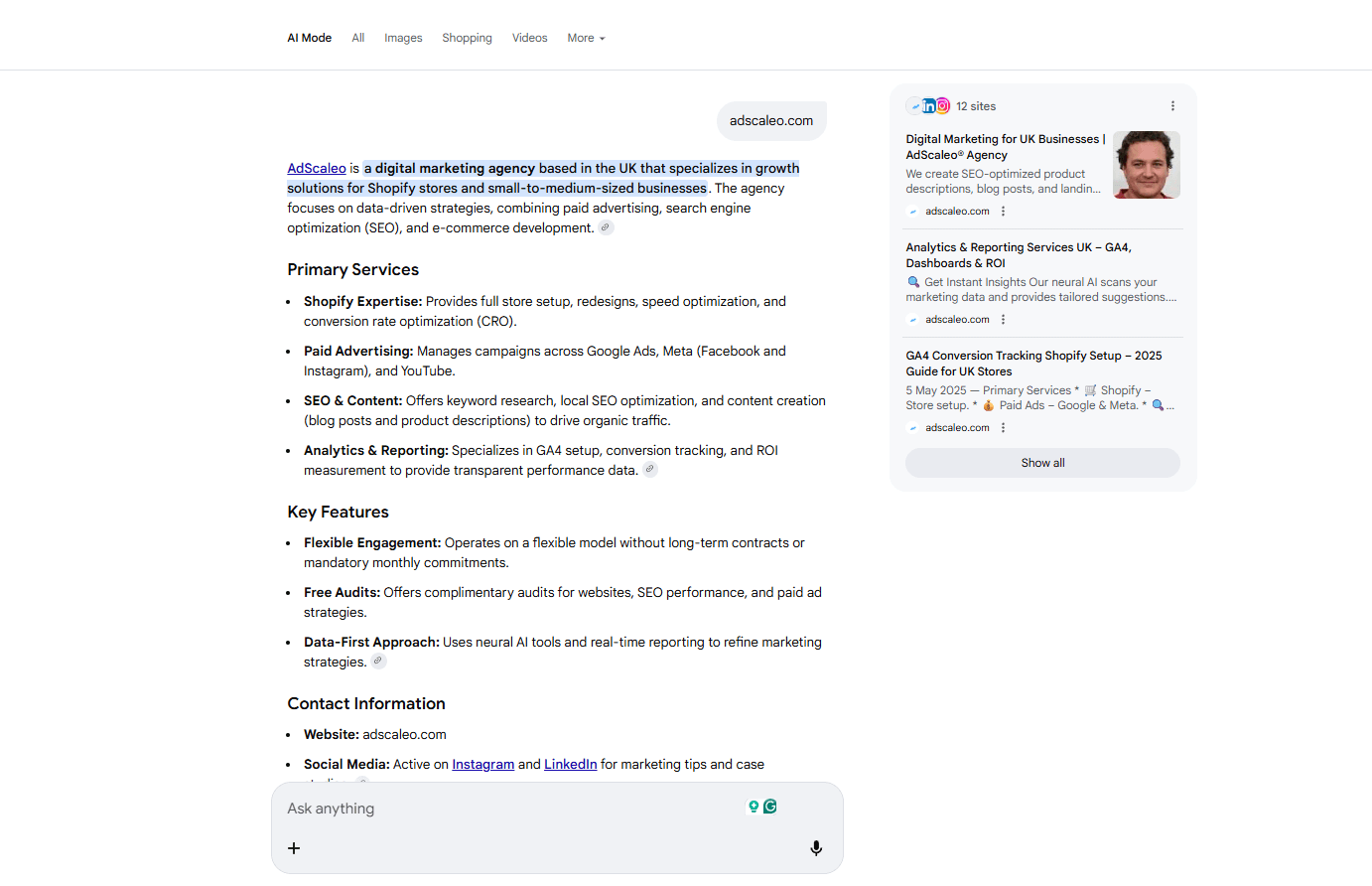
Google AI Overviews SEO example showing AdScaleo cited in AI search summary

Notice how AI summaries often pull short descriptions and then show supporting sources. That’s exactly what we’re optimising for in this guide.

2) How AI chooses which sources to cite (in plain English)

Google doesn’t want AI summaries to be misleading, so it tends to cite sources that feel clear, relevant, and safe to trust. The easiest way to think about it is this: the more “quotable” and “verifiable” your page is, the more likely it is to be used as a supporting source.

That’s why Google AI Overviews SEO is less about hacks and more about presentation + proof. If a page is vague, overly promotional, or messy, AI systems struggle to summarise it accurately — and users struggle to trust it.

To keep this guide grounded, we’re aligning it with Google’s own documentation: Google Search Central: AI features and helpful, reliable, people-first content guidance .

What AI tends to look for What you should add on your page Why it matters for Google AI Overviews SEO
Clarity (easy to summarise) A short definition + a “quick answer” paragraph near the top AI is more likely to cite pages it can quote accurately without guessing
Intent match (answers the exact query) Step-by-step guidance, examples, and clear sub-headings that match real searches Even a great page won’t get cited if it doesn’t directly answer what the user asked
Evidence (proof & examples) Screenshots, tools used, real processes, mini case examples, measurable outcomes (when possible) Evidence reduces risk — it makes your content easier to verify and safer to cite
Trust signals (who, why, legitimacy) Clear authorship, About page, service pages, contact details, policies, and transparent claims Trust signals help Google feel confident your site is legitimate and reliable
Readable structure (easy to scan) Short paragraphs, bullets, tables, and consistent heading hierarchy (H2 → H3) Structure improves comprehension for users and makes AI summaries more accurate
Tip: Swipe sideways to view the full table on mobile.

Next, we’ll turn this into a simple framework you can apply to any page — so your content becomes more citable without sounding robotic or keyword-stuffed.

3) The AdScaleo CITE Framework (built for Google AI Overviews SEO)

If you want a simple way to make your content more “AI-citable”, use this framework. We call it CITE because it focuses on the signals that increase the chance your page gets quoted as a supporting source in AI summaries.

In plain terms, Google AI Overviews SEO improves when your page answers quickly, proves real expertise, and makes it easy for both users and AI systems to trust what’s written.
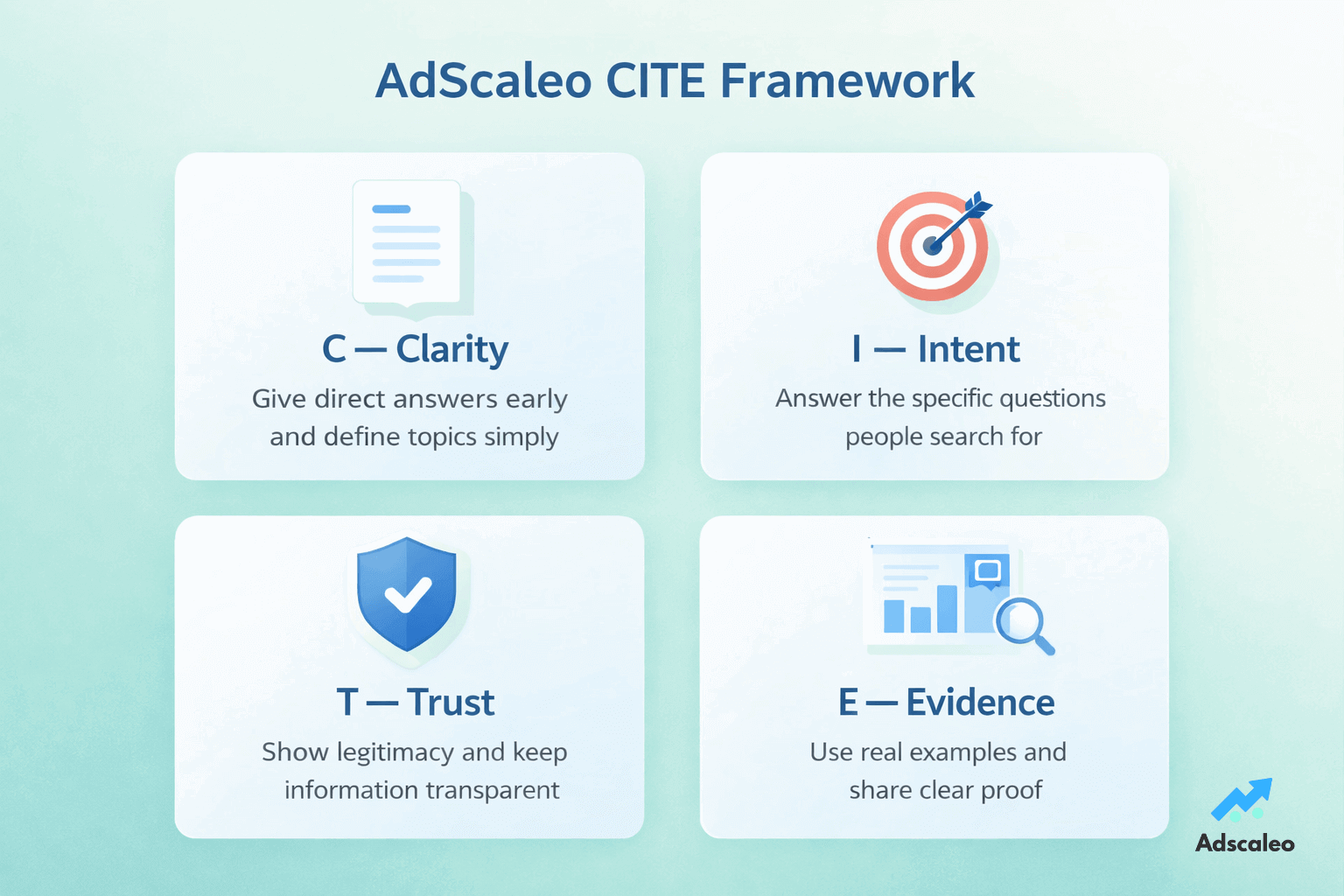
Google AI Overviews SEO CITE framework by AdScaleo (Clarity, Intent, Trust, Evidence)

AdScaleo CITE Framework for Google AI Overviews SEO: Clarity, Intent, Trust & Evidence.

C — Clarity (make it easy to quote)

Start with a clean definition and a direct answer. Avoid long intros. Your first 5–10 lines should explain what the reader needs, in plain language. If AI can’t extract a clean answer, it’s less likely to cite the page.

I — Intent (answer what was actually searched)

Match the search intent precisely. If the query is “how to get cited in AI Overviews”, your page should give steps and examples directly — not a generic SEO lecture. Intent-match is one of the biggest advantages in Google AI Overviews SEO.

T — Trust (make your site safe to cite)

Trust comes from transparency. Add author information, an About page, clear contact details, and avoid claims you can’t support. This is where E-E-A-T fits naturally: experience, expertise, authority, and trust.

E — Evidence (prove it with examples)

Evidence can be simple: screenshots, short mini-examples, real process steps, and the tools you use. The goal is to make your advice verifiable. Evidence is often what separates “helpful content” from “content that sounds helpful”.

Quick summary: If your page is clear, matches the intent, feels trustworthy, and includes evidence, you greatly improve your chances of performing well in Google AI Overviews SEO.

4) Content formats that perform best for Google AI Overviews SEO

The fastest way to improve Google AI Overviews SEO is to use content formats that are easy to summarise and easy to verify. Instead of writing long “opinion-style” posts, aim for structured content that answers the query directly.

Do this (more citable) Avoid this (hard to cite)
Definition + quick answer in the first few lines Long intros that delay the answer
Step-by-step guides with clear outcomes Vague advice like “just create good content”
Tables + comparisons (Option A vs Option B) Dense blocks of text with no structure
Checklists readers can apply immediately Generic lists with no clear action
FAQs matching real searches + short answers FAQ pages full of fluffy paragraphs
Evidence: screenshots, tools used, mini examples Overclaims without proof (hurts trust)

If your content is easy for a human to scan and apply, it’s usually easier for AI to summarise and cite too — which is the core idea behind Google AI Overviews SEO.

Quick Checklist: Make your content more “AI-citable”

  • Answer the query within the first few lines
  • Use clear headings, bullets, and at least one table
  • Add evidence (examples, screenshots, tools, steps)
  • Keep it specific and avoid vague marketing language
  • End with a clear action step the reader can apply

5) On-page SEO that still matters (especially for AI)

Even with AI summaries, on-page SEO still matters because Google needs to understand your page clearly before it can trust it as a supporting source. The difference now is that Google AI Overviews SEO rewards content that is not only optimised — but also easy to extract, well-structured, and credible.

Use the checklist below as a practical reference when writing blogs, service pages, Shopify pages, or landing pages. It’s designed to improve readability for humans and citation-quality for AI.
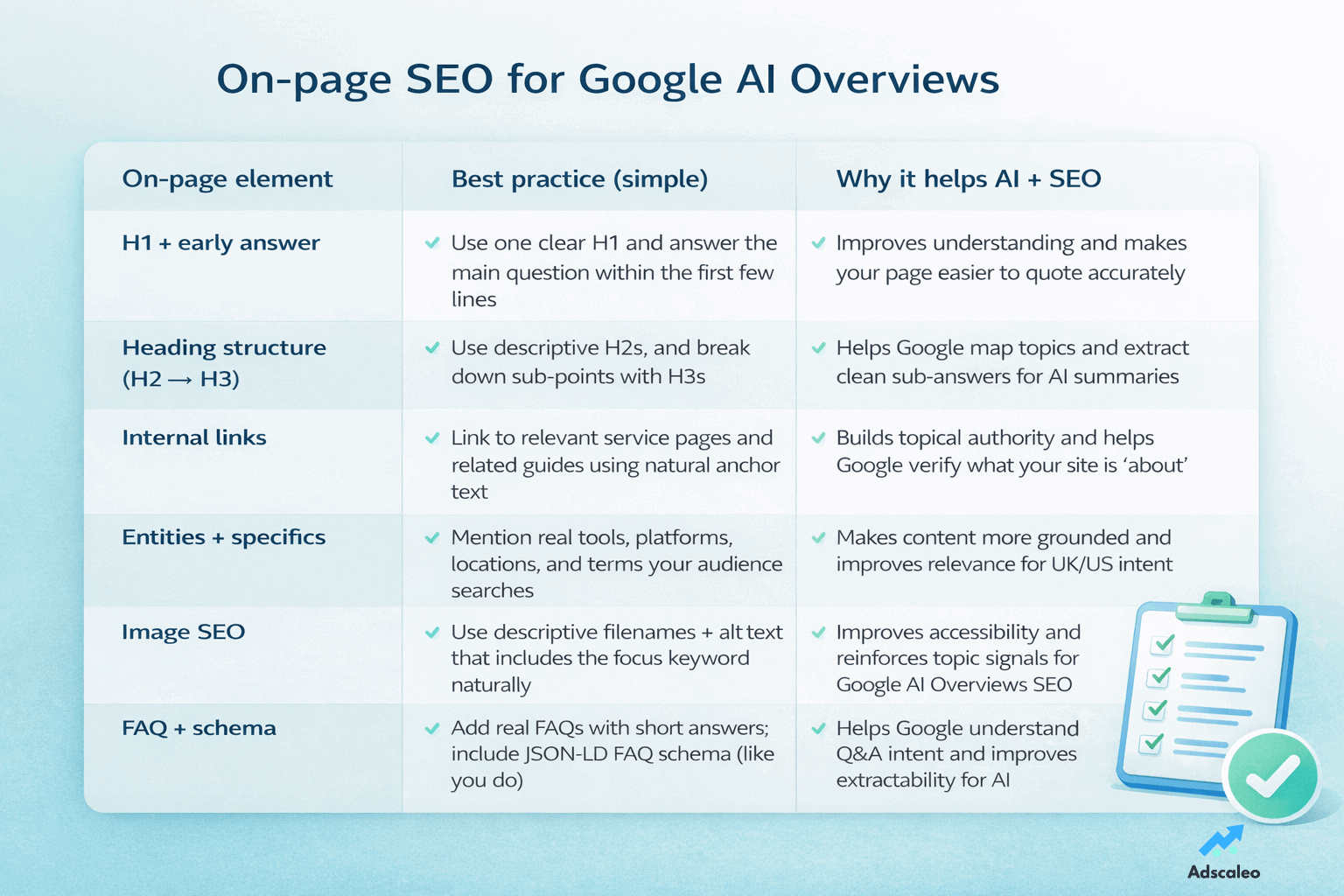
Google AI Overviews SEO on-page checklist showing headings, internal links, image SEO and FAQ schema

On-page checklist for Google AI Overviews SEO: make your content easier to understand, summarise, and cite.

Quick on-page improvements you can apply today

  • Answer first, then explain: include a direct answer within the first few lines before you expand.
  • Make headings “search-like”: write H2s that look like real questions people ask (it helps both readers and AI summaries).
  • Use internal links for context: link to your relevant service pages so Google understands your topical expertise.
  • Optimise images properly: descriptive file names, useful alt text, and a short caption where relevant.
  • Support key claims: add examples, tools used, or a reference link when you’re giving important advice.
  • Keep it scannable: short paragraphs, bullets, and one summary box per major section.

If you want help applying these improvements across your website, explore our SEO Services UK — built for small businesses that want measurable growth (not vague “SEO promises”).

Helpful tools: For keyword research and content planning, tools like Semrush and Ahrefs can help you find what people actually search for. And for best-practice guidance straight from the source, use Google’s SEO Starter Guide.

6) Trust signals that help you get cited (E-E-A-T done properly)

If you want better results from Google AI Overviews SEO, you can’t ignore trust. AI summaries are designed to reduce risk — so Google is more likely to cite sources that look legitimate, transparent, and genuinely helpful. This is where E-E-A-T matters: Experience, Expertise, Authoritativeness, and Trust.

The good news: you don’t need a huge brand to build trust. You just need to present real expertise clearly and avoid claims you can’t support — especially if you’re a local business in the UK or USA.

Do this (build trust) Don’t do this (reduces trust) Real-world example
Be specific: list services, coverage areas, and what customers should expect Generic claims like “best in town” with no details Coffee shop: “Specialty espresso, oat milk options, vegan pastries, open 8–6, near Oxford Street.”
Show proof: reviews, photos, certifications, case examples, before/after (where appropriate) Big promises without evidence Estate agent: “Recent sold prices, marketing process, average time to sell, client testimonials.”
Be transparent: who wrote it, why they’re qualified, and how to contact you Anonymous content with no author, no contact, no accountability Dental clinic: “Written by Dr. X, registration, treatment steps, consultation booking.”
Write practitioner content: explain your process, steps, and what changes after the work Fluffy marketing paragraphs with no practical guidance Personal trainer: “4-week plan structure, nutrition basics, progress tracking, realistic outcomes.”
Stay accurate: avoid medical/legal guarantees; use careful wording and references where needed “Guaranteed cure”, “instant results”, or misleading statements Doctor/clinic: “Common options” + “consult a professional” + clear disclaimers.
Tip: Swipe sideways to view the full table on mobile.

Simple takeaway: For Google AI Overviews SEO, trust is not about sounding impressive — it’s about being easy to verify. Clear authorship, transparent details, real examples, and accurate wording make your site safer to cite.

Next, we’ll cover one of the most practical tactics for Google AI Overviews SEO: creating “snippet-ready” sections that AI can quote cleanly — without rewriting your meaning.

7) Create “snippet-ready” sections that AI can quote cleanly

Here’s one of the most practical tactics for Google AI Overviews SEO: write small sections that are easy to quote without changing the meaning. Think of it like this — if your answer can be copied into a summary and still makes sense, you’re doing it right.

This works for blog posts, service pages, Shopify pages, local business pages, and FAQs. You don’t need to “write for AI” — you just need to write with clarity and structure.

If you want practical, beginner-friendly improvements you can apply alongside this strategy, read our guide: SEO Tips for UK Small Businesses (2025) — 10 quick wins for better visibility and rankings.

Snippet-ready template 1: Definition + 3-line answer

What is Google AI Overviews SEO?
Google AI Overviews SEO is the process of structuring content so Google can accurately summarise it and cite it as a supporting source in AI-generated search results. It focuses on clarity, intent-match, trust signals, and evidence — not just rankings.

Tip: This format works best when the first sentence is simple, and the next lines add the “how” and “why”.

Snippet-ready template 2: Steps (short + scannable)

  1. Answer first: write a direct 2–4 line answer near the top.
  2. Break it down: use H2/H3 headings that match real searches.
  3. Add proof: include an example, screenshot, tool, or reference.
  4. Summarise: finish with a short checklist box.

Common mistakes that stop AI from citing your page

  • Hiding the answer under long intros
  • Writing vague marketing language instead of practical explanation
  • No structure (no headings, no bullets, no summaries)
  • Overclaiming without proof (hurts trust)
  • Mixing multiple topics on one page with no clear direction

Quick takeaway: To improve Google AI Overviews SEO, write in “quotable blocks”: short definitions, clear steps, real examples, and a simple summary at the end.

8) A simple 7-day action plan for Google AI Overviews SEO

If you’re a UK or US business owner, you don’t need a huge SEO project to start benefiting from Google AI Overviews SEO. You just need to improve a few key pages so they become clearer, more verifiable, and easier to cite.

Day What to do Result you’re aiming for
1 Pick 2–3 pages to improve first (one service page + one blog + one homepage/landing page). Focus effort where it matters most (not everywhere).
2 Rewrite the first 10 lines to include a clear definition + direct answer. Your page becomes easier to summarise and quote.
3 Add 1 checklist (or table) + 1 real example (tools used, screenshot, or process). More structure + more evidence.
4 Improve internal links (service → blog, blog → service). Use natural anchor text. Stronger topical authority and context.
5 Add trust signals: author box, contact, policies, and realistic wording (no overclaims). Your content looks safer to cite.
6 Add 5–8 FAQs people actually ask + your hidden JSON-LD FAQ schema. Better extractability and relevance.
7 Measure: check Search Console impressions + update one section weekly. Continuous improvement without overwhelm.
Tip: Swipe sideways to view the full table on mobile.

Want help applying this plan across your website? Explore our SEO Services UK — built for small businesses that want clear, measurable improvements (not vague SEO promises).

9) FAQs about Google AI Overviews SEO (quick, practical answers)

Does ranking #1 guarantee you appear in AI Overviews?

No. Rankings help, but AI Overviews often cite sources that are clearer, more structured, and easier to verify — even if they’re not #1.

What’s the fastest improvement you can make?

Rewrite the first 10 lines to include a direct answer, then add one table/checklist + one real example (tools, steps, screenshot).

Should UK and US businesses write different content?

The framework is the same, but local intent changes. Use region-specific language (UK vs US terms), services, and examples where relevant.

Does FAQ schema help for AI?

Schema doesn’t guarantee an AI citation, but clear FAQs improve structure and intent-match, which supports better extraction and understanding.

🎯 Wrapping Up: Get Cited by Google AI with Clear, Trusted Content

Google AI Overviews SEO isn’t about chasing a trend — it’s about making your content easier to understand, easier to verify, and safe enough to cite. When your pages are structured, evidence-led, and written with real-world clarity, you give Google’s AI a reason to reference your website as a trusted source.

Whether you’re a local business in the UK, a service provider in the USA, or an eCommerce brand trying to grow — the same rule applies: build pages that answer questions directly, show proof, and guide visitors confidently to the next step.

Want a simple, expert-led plan to improve your visibility in AI search results? We can help.

🚀 Get Help With SEO & AI Visibility →

✅ Want to explore more? Check out: SEO Tips (2026 Guide), Analytics & Reporting, and Website Setup Services.

×

🚀 Free Website Audit for UK Businesses

We'll analyse your site’s speed, SEO, and tracking — and send custom tips within 48 hours.

💡 Claim My Free Audit ⏳ Only a few audit slots left this week!
AdScaleo Logo
Written by: AdScaleo Team
Shopify • SEO • Paid Ads • Analytics

We help small businesses grow with Shopify optimisation, SEO, paid ads and analytics—using clear strategy, clean implementation and transparent reporting.

Scroll to Top